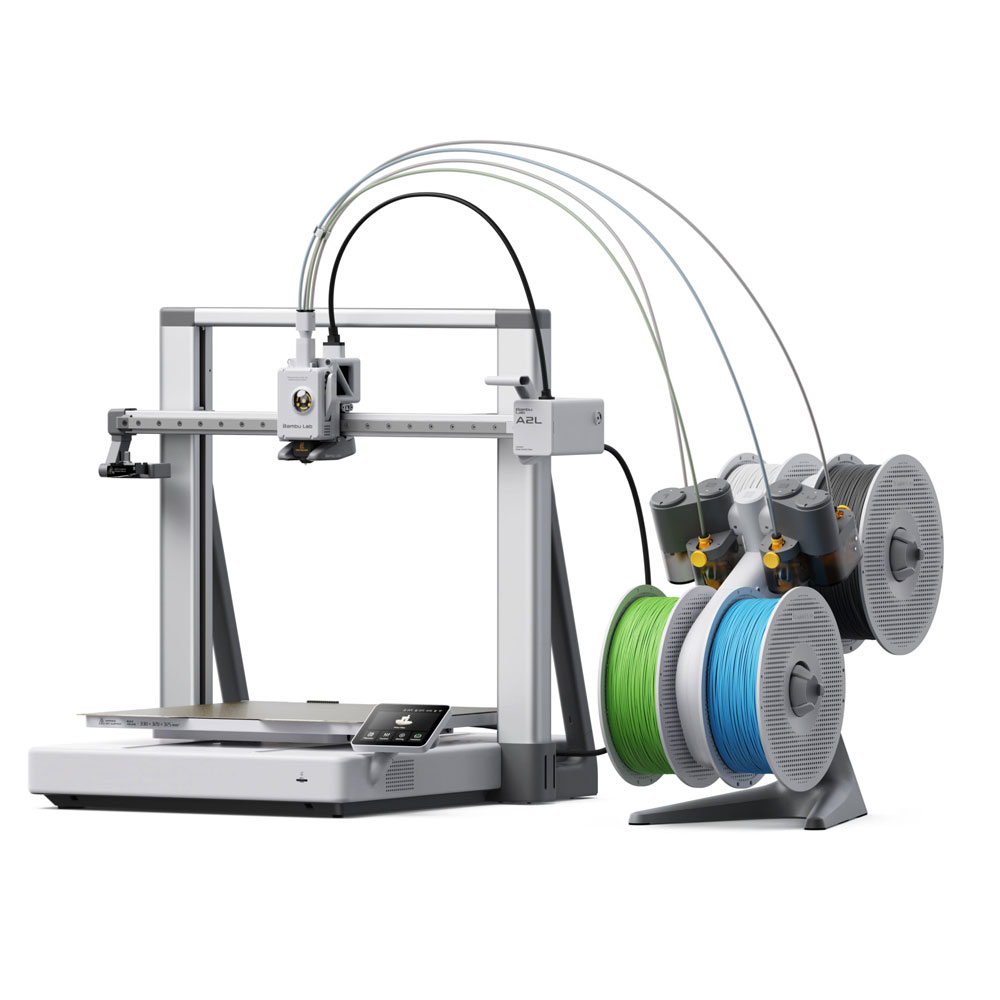
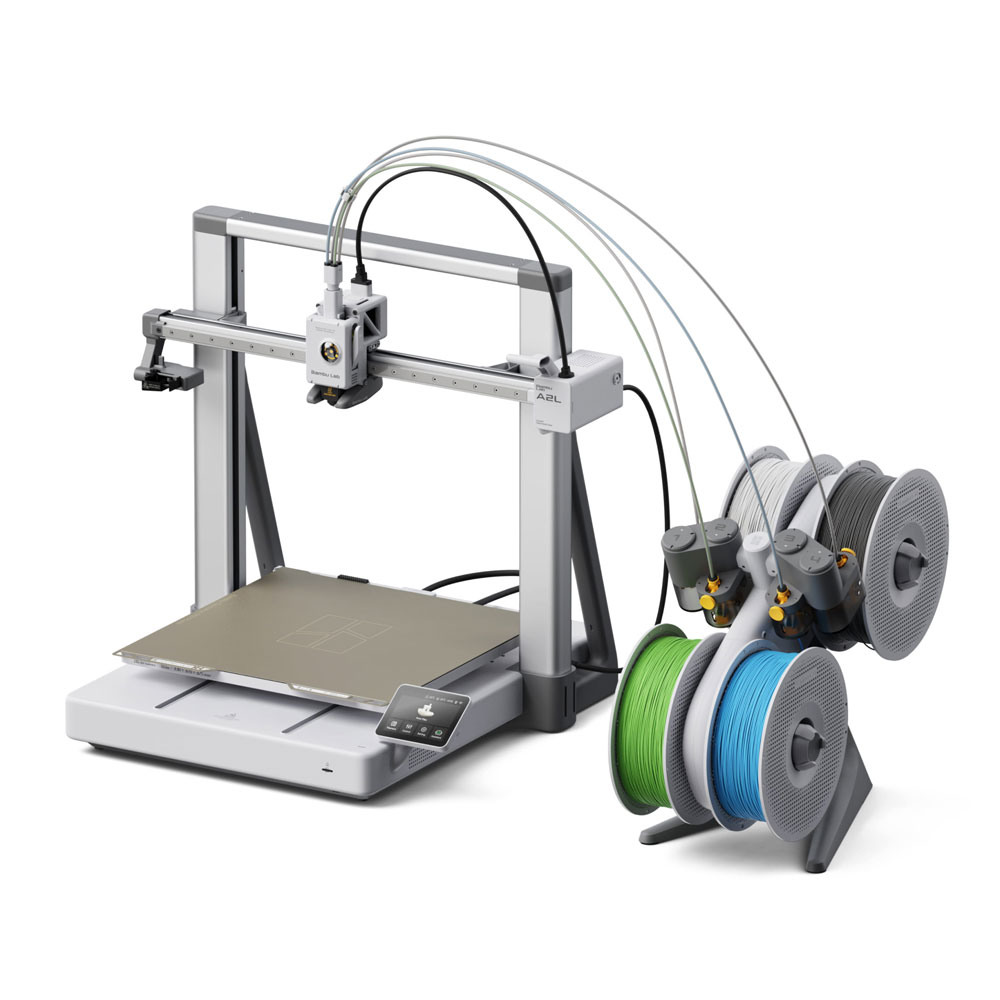
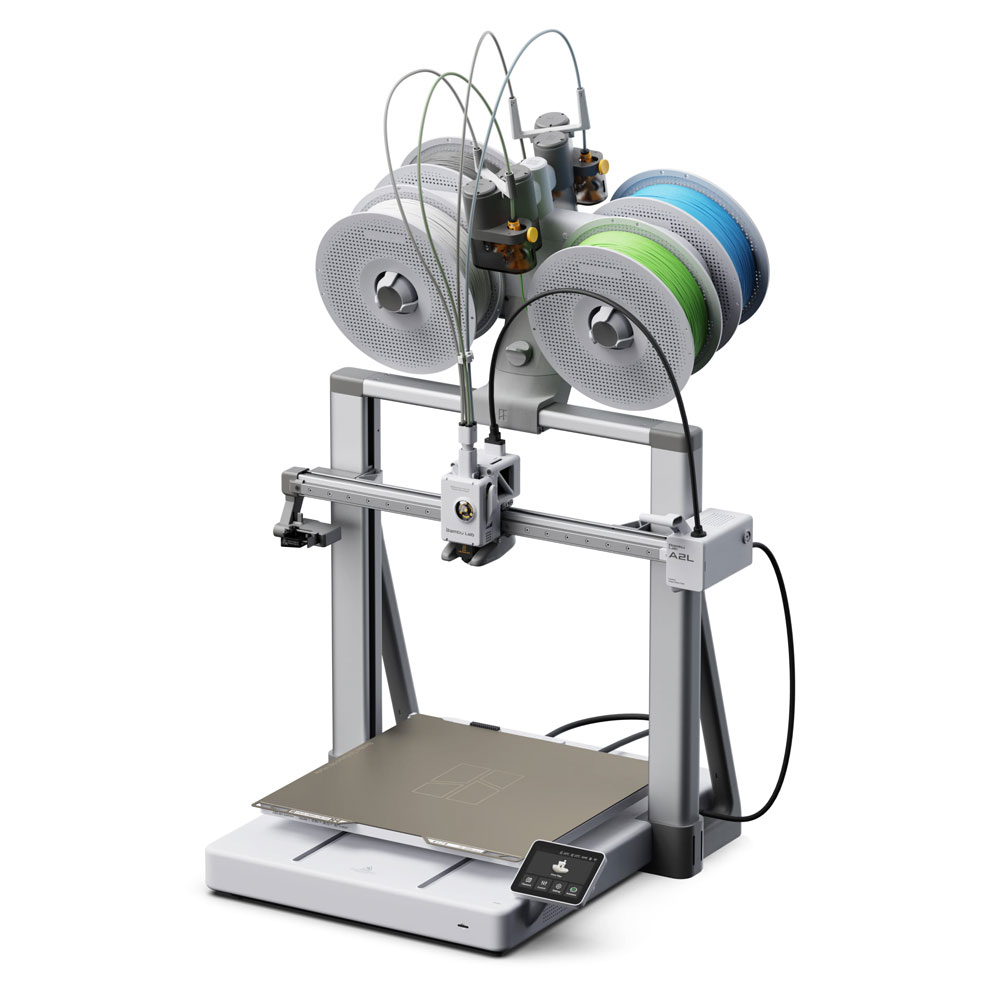
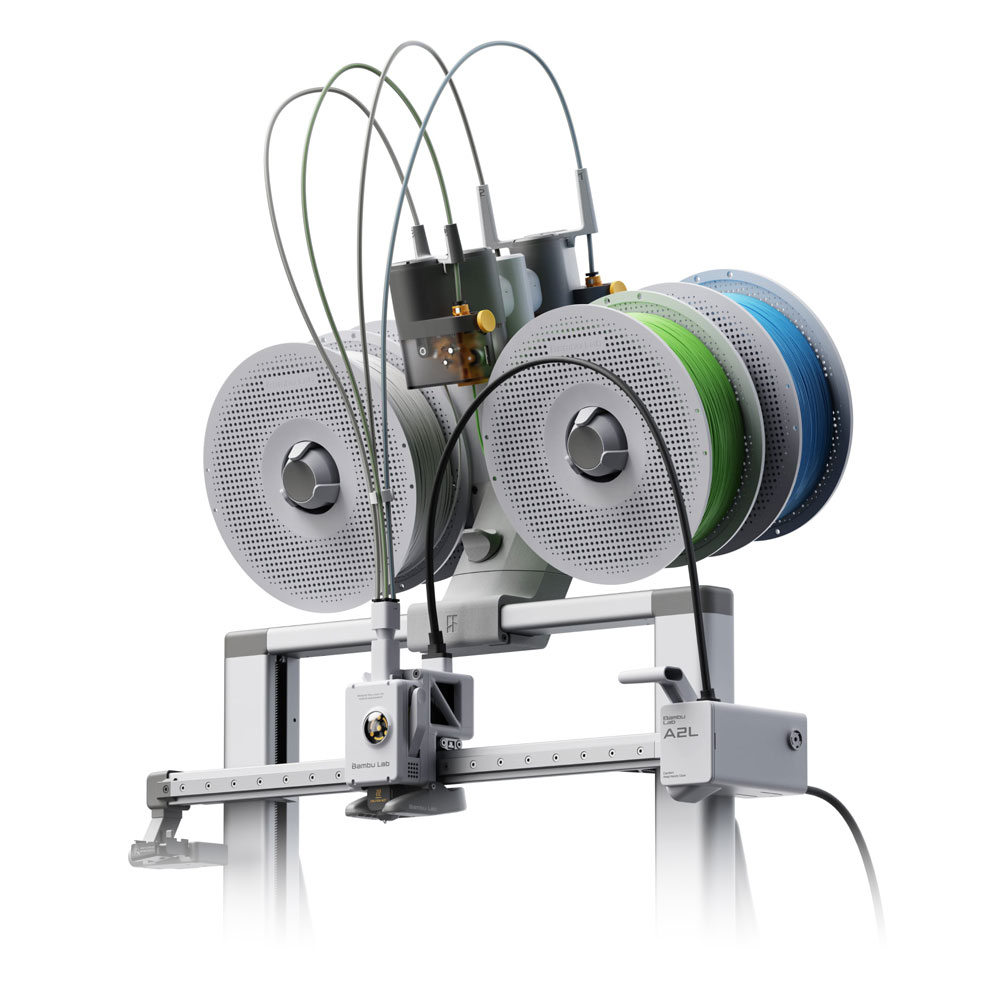
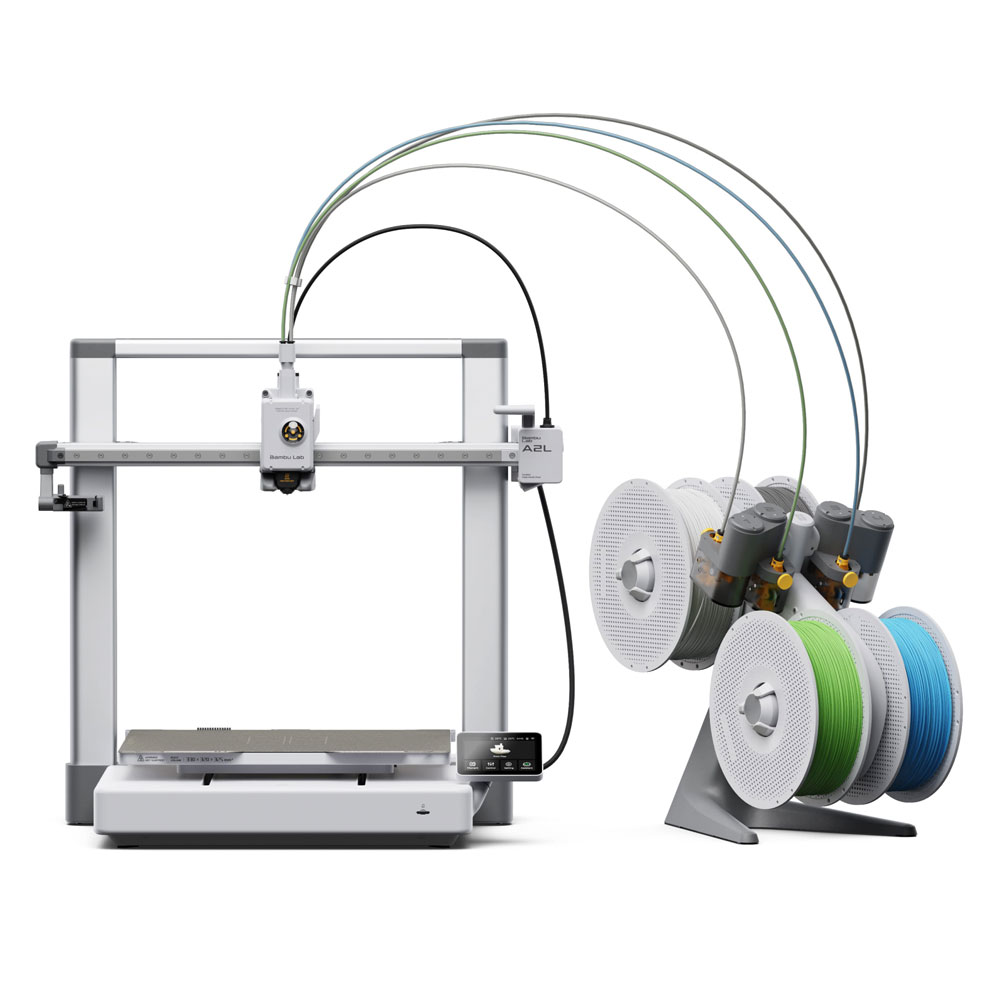
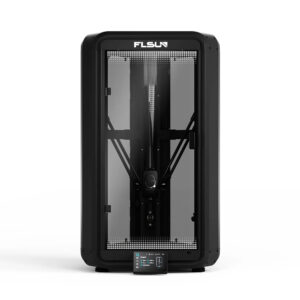
Bambu Lab A2L AMS Combo 3D Printer
Product Features:
- Expanded Build Volume: 330 x 320 x 325 mm³ for large-scale projects.
- Multi-Tool Ecosystem: Supports modular add-ons for blade cutting and pen plotting.
- Full-Auto Calibration: Hands-free leveling and offset for instant out-of-the-box printing.
- Pro-Scale Stability: Adaptive Vibration Compensation guarantees precision for heavy/tall models.
- AMS Integration: Reliable, high-performance multi-color and multi-material printing.
- Smartphone-Class UI: High-resolution touchscreen with a streamlined, user-centric interface.
- Indoor Safe: UL 2904 GREENGUARD certified for emission safety.
* Cybersecurity compliant with EU RED Article 3.3(d)(e) and ETSI EN 303 645 V2.1.1:2020.
Bambu Lab A2L – Creative Playground. Extra Large.
Why choose Bambu Lab A2L?
Extra Large Build Volume
Oversized build in one go.
Multi-Colour Printing
The most reliable multi-colour solution.
Full-Auto Calibration
You don’t have to do ANY manual tuning.
Modular Add-Ons
Blade cutting, pen drawing and more.
Maker World Ecosystem
Millions of models, one-click away.
Intelligent Monitoring
Auto Pilot your printing process.
Oversized Build Volume
Extra Large Volume for Extra Bold Ideas. 330 × 320 × 325 mm. That’s 105% more space than the 256 mm class. A full-scale helmet, in one piece. A batch of 40 fidget toys, in one run. The kind of project that used to mean slicing your model into chunks — or starting over when the seams didn’t line up — now just fits.
Modular Add-ons – Add a New Dimension with Blade Cutting
Swap the tool-head cover for the cutting module, and the A2L isn’t just a printer anymore — it cuts. Stickers, leather, fabric, paper. Custom livery for your model plane? Done. A leather wrap for the handle of your Excalibur? Done.
Engineered for Stability
A Bed-Slinger as stable as Core XY
Adaptive Vibration Compensation
A model gets taller. It gets heavier. The way the machine vibrates changes with it. Most printers run input shaping once at startup and call it done. The A2L runs Adaptive Vibration Compensation — a real-time calibration matrix that factors in both the tool-head position and the shifting bed load. Retuning the resonance model layer by layer as the print grows. The last layer comes out as clean as the first.
Granular Damper
Software handles the vibration it can predict. Hardware handles the rest. Inside the A2L’s Gantry sit two Granular Dampers – sealed chambers packed with fine particles that dissipate vibration through countless micro-collisions. It’s a damping technique borrowed from aerospace and precision machinery, rarely seen in desktop 3D Printers. The result: surface ripples and ghost lines stay out of your prints, even at full build height.
Automatic Material System – Multi-Color Made Easy
Multi-color printing isn’t new. Doing it thousands times in a row, without a single jam, is. That’s the bar AMS lite is built to clear. Over a million users worldwide have put it through long, color-heavy prints — the kind where one bad swap ruins twelve hours of work — and it keeps swapping.
Support 2nd-Gen AMS
Pair the A2L with the 2nd-Gen AMS, and your filament gets a sealed, climate-controlled home — dried on demand before each print, kept airtight between them. Need more colors?
Need different material types running side by side? AMS lite and the 2nd-Gen AMS share the same embedded buffer system, so you can stack and mix them: four spools, eight spools, sixteen spools — whatever your project asks for, fed cleanly through one queue.
19-Colour Printing – Filament Drying – Enclosed Storage
Intelligent Print Monitoring – Put Your Printing on Autopilot
Most print failures happen quietly — the nozzle keeps moving, but the part stopped forming hours ago.
Sensors along the extrusion path, paired with the PMSM extruder as a feedback node, feed a Bambu-trained algorithm that catches filament tangle, runout, nozzle clumping, and air printing — then pauses A2L and guides you through the fix on Bambu Handy.
- Nozzle Clumping Detector
- Filament Grinding
- Air Printing
Auto Flow Dynamics Calibration – Repeatable Sharp Print Details
Most printers calibrate flow once and trust it for every print after. A2L recalibrates every time. Before each job, Flow Dynamics Calibration measures how filament actually flows through this nozzle, with this spool, and builds a nonlinear model of the entire extrusion path. Nozzle wear, filament moisture, a fresh roll — all factored in before the first layer goes down. Sharp corners. Clean details. Print after print.
UL Clean Air Certified – Print with Confidence, Breathe with Peace of Mind
The A2L is certified under the UL 2904 standard for 3D printing indoor air quality when used with official filaments. Testing with our core lineup — including Bambu PLA Basic, PLA Pure, and PETG Basic — confirms ultra-low emissions, making the A2L safe for indoor use.
Engineered for Silence – Print Quietly. Work Comfortably.
The A2L uses active motor noise cancellation, precision linear rails, and intelligent fan scaling to deliver a seamless experience. In Silent Mode, it operates at just 49dB — as peaceful as a quiet library.
Connect Your Way – Your printer, your privacy.
Use Bambu Cloud for effortless cross-device connectivity, or switch to LAN-only mode for a secure, local-network experience. Total control over how you connect.