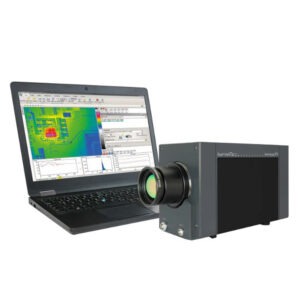
InfraTec ImageIR® 6300 Z – Radiometric Zoom Camera for Greater Efficiency
Smaller, lightweight, without tedious lens changes – efficiency has a new name: The ImageIR® 6300 Z with a powerful zoom lens and a SWaP detector (Size, Weight and Power).
- Flexible field of view adjustment thanks to a universal zoom lens with motorised focus
- Very long cooler running times, ideally suited for continuous operation
- Very small, lightweight, and robust camera for space-saving system integration
- High geometric resolution thanks to 10 µm pixel pitch
Detector Format 640×512
Modern XBn detector; 10 μm pitch
Measurement Accuracy
Repeatable measurements for different fields of view
Motor Focus
Precise, fast and remotely controllable, including multiple autofocus functions
Zoom Lens
7.5× zoom lens; focal length ranges (15 … 115) mm or (25 … 170) mm
High-speed Mode
Increase frame rates and thermal resolution at the same time using binning technology
Long-life Cooler
Enables the maintenance-free use over long operating times
ImageIR® 6300 Z: One For All (Measurement Tasks)
Thanks to its universal applicability, the ImageIR® 6300 Z is ideal for demanding temperature measurements in research and development. It is suitable as well for stationary or flight-based inspection and monitoring tasks. The thermographic zoom camera is also well-suited for quality assurance or material testing. In addition, it is suitable for integration into production processes.
The ImageIR® 6300 Z from InfraTec owes its flexibility to the integrated 7.5× zoom lens. Motorised focus enables quick and convenient focusing on any measurement object. In addition, users can adjust the desired field of view at the touch of a button while maintaining the same resolution and a constant measurement distance.
No further adjustments are required to obtain accurate measurements, as the zoom camera is radiometrically calibrated across the entire focal length range.
Online Events On Demand: Thermal Imaging with Zoom
Event On Demand
Unlimited Flexibility in Thermal Imaging with Zoom
- Motorised zoom lenses in general
- Radiometric zoom lens specialties
- Specific motorised zoom camera advantages
- Applications for infrared zoom cameras in detail
Small, Light, Radiometrically Calibrated
The heart of the infrared camera is the SWaP detector, a cooled focal-plane array photon detector with a format of (640 × 512) IR pixels, which operates shutterless and in snapshot mode.
For the innovative XBn detector used, a smaller Stirling cooler with lower power is sufficient due to the higher working temperature, which reduces the overall power consumption, dimensions and weight of the ImageIR® 6300 Z and significantly extends the maintenance-free service life.
As no shutter is required in continuous operation, process data can be collected without interruption and with high measurement accuracy. In addition, the Zoom camera combines different focal lengths in one system. It is radiometrically calibrated over the entire focal length range.
No Extensive Lens Change
The consistent use of the latest technologies in optics, detectors, and electronics is the basis for the remarkable user-friendliness of the camera series. The thermal imaging ImageIR® 6300 Z has a 7.5× zoom lens integrated as standard. In combination with the motorised focus, this allows a fast and flexible adjustment to different object distances and sizes. At the same time, stable image quality and high measurement accuracy are maintained.
Using a teleextender can increase the camera’s range by approximately 1.5 times.
Powerful Image Processing Electronics
The ImageIR® 6300 Z has high-performance image processing electronics and can output the IR image data in real time to several video and data interfaces. Furthermore, it can record and evaluate it autonomously. This camera can also be operated via smartphone or tablet using its web interface. With these features and the possibility to power it from an external battery, this camera is ready for mobile outdoor use.
The Zoom camera can be easily integrated into existing system environments in a space-saving way. It is suitable for universal use in research and development. Moreover, it is also suitable for integration into GIMBAL systems in the field of flight thermography.
Detect Smallest Temperature Differences Using High Thermal Resolution of 30 mK
The thermal resolution of the ImageIR® infrared camera series allows you to measure the smallest temperature differences of better than 0.03 K (at 30 °C). Thermal images with a narrow temperature span display details absolutely sharp. Therefore, you will find interesting signatures even where other infrared camera systems cannot detect any temperature differences any longer.
High-speed Mode to Increase Frame Rates and Thermal Resolution at the Same Time
If you want to analyse the thermal behaviour of objects and processes from a wide variety of perspectives, you can use the high-speed mode for maximum flexibility. This function allows the camera to be used in two different operating modes. The standard mode is best for depicting the smallest geometrical details. As a result, users can record images with the native number of pixels of the camera detector.
Switching to high-speed mode opens up the option of more than triple the frame rate, while the field of view (FOV) remains identical. This enables the most accurate time monitoring of fast processes. At the same time, the thermal resolution increases by a factor of 2 in high-speed mode. Thus, this additionally improves the analysis of temperature differences.
Integrated Software Development Kit
A new generation of electronics is entering the field of thermography, allowing an operating system to be embedded directly in the camera (embedded system). In addition to the well-known benefits of a Software Development Kit, the integrated SDK opens up numerous other possibilities for users:
- Independent operation of the camera without a PC
- Automated control of camera functions with the aid of the integrated SDK
- Implementation of evaluation algorithms and camera control based on these algorithms directly in the camera
These SDK functions make it possible to let the thermography camera run autonomously. If programmed appropriately, the camera no longer requires a permanent, stable network connection to a PC. Due to this, it is ideal for use in hard-to-reach places and facilitates integration into and adaptation to existing systems.
The new integrated Software Development Kit was developed and optimised by InfraTec in collaboration with customers from industrial and research environments.
Further Features of this Camera at a Glance
High-speed Mode
Faster Measurement with a Constant Field of View
Due to binning technology, infrared cameras have an additional high-speed mode in which the frame rate increases to more than three times, and the thermal resolution can be doubled.
Motor Focus
Remote-controlled Focusing of the Thermal Image
Interchangeable standard lenses in the ImageIR® series can be equipped with a motor focus unit. This enables precise, remote-controlled and fast focusing via the operating software.
Window Mode
Fast Measurements in Defined Subsections
Capture very fast temperature and motion sequences in full, half, quarter and sub modes, as well as in sub image formats defined by click-and-drag, using high frame rates.
Trigger Interface
Interface for Incoming and Outgoing Control Signals
Trigger signals to or from the camera can be used to control and synchronise image data acquisition. Thermographic measurements can also be used to control processes.
GenICam software interface
The GenICam software interface, in conjunction with the GigE Vision interface, enables easy integration of infrared cameras into existing systems. The cameras are automatically detected.