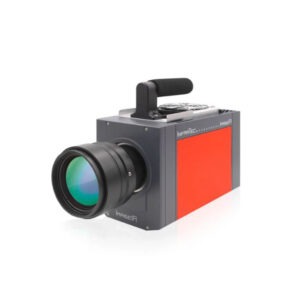
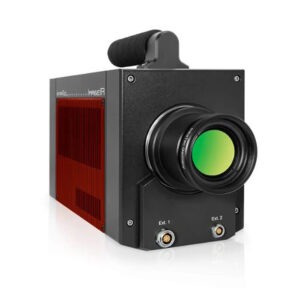
InfraTec ImageIR® 9800 – LWIR Camera for High-resolution Outdoor Measurements
The new ImageIR® 9800 is the ideal device for high-resolution thermographic measurements of highly dynamic processes, even at low object temperatures. The radiometrically calibrated infrared camera operates in the long-wave atmospheric window (LWIR). It delivers razor-sharp images and distortion-free sequences even with short integration times and at low radiation intensity.
This is made possible, among other things, by a cooled focal plane array photon detector with (1,280 × 1,024) IR pixels and a pixel pitch of 12 µm.
- Short integration times for analysing fast processes, even at low radiation intensities
- Measurement of objects at great distances using telephoto lenses
- Sharp and distortion-free images, even for fast-moving objects
- Thermal resolution of 0.03 K and measurement accuracy of 1%
Detector Format
High-resolution thermal images for monitoring large areas
Measurement accurancy 1%
Highly accurate and repeatable measurements
IR frame rate 180 Hz at 1,280 x 1,024 IR pixels
Analysis of extreme temperature changes and gradients in full frame
Thermal Resolution better than 30 mK
Precise detection of smallest temperature differences @30°C: 0.03 K
Pitch Dimension 12 µm
Smaller pixel sizes avoid geometrical measurement errors
Shortest Integration Time
Accurate temperature measurements of fast processes
Spectral Range
Measurement in the range of (7.7 … 12.5) µm
Fast Measurement, Broad Temperature Range
The ImageIR® 9800 allows full-frame images to be captured at frame rates of 180 Hz. In sub-frame mode, the frame rate can be increased to more than three times this value.
Thanks to extremely short integration times and snapshot mode, all detector pixels are exposed simultaneously instead of sequentially, line by line. As a result, images remain sharp and distortion-free even when test objects move at high relative speeds within the image field. This is essential for accurate, unadulterated thermographic temperature measurement.
Precise analysis of fast-moving objects is further supported by a wide range of trigger options for pinpointed, repeatable, time- or event-controlled data recording.
This new high-end InfraTec camera also demonstrates its strengths in tasks such as monitoring combustion gases or exhaust gas flows from vehicles at long distances. Thanks to the HDR function, the ImageIR® 9800 can capture extremely large temperature gradients and variations between -40 °C and 3,000 °C fault-free and continuously. Additionally, an integrated filter wheel automatically provides filters appropriate for the respective measurement range.
When it comes to detecting thermal signatures and distant objects, the ImageIR® 9800 is the perfect counterpart to the ImageIR® 9400. Both IR cameras are equipped with high-resolution SXGA detectors and cover a wide field of view (FOV). Their spectral ranges – (7.7 … 12.5) μm and (1.5… 5.5) µm – complement each other perfectly.
10 GigE Interface
Ultra-fast Data Transfer
High-resolution detectors and high frame rates generate large amounts of data. With the 10 Gigabit Ethernet interface, this data can be transferred quickly, reliably and without loss.
Modular Concept
Customised Configuration and Retrofitting
Due to their modular design, the cameras in the ImageIR® series can be adapted to user requirements and retrofitted or converted if measurement requirements change.
Window Mode
Fast Measurements in Defined Subsections
Capture very fast temperature and motion sequences in full, half, quarter and sub modes, as well as in sub image formats defined by click-and-drag, using high frame rates.
Multi Integration Time
Temperature Measurements Across Multiple Calibration Ranges
This function allows continuous temperature measurements to be carried out with constant aperture and filter settings. It covers more than one calibration range.
Trigger Interface
Interface for Incoming and Outgoing Control Signals
Trigger signals to or from the camera can be used to control and synchronise image data acquisition. Thermographic measurements can also be used to control processes.
Motor Focus
Remote-controlled Focusing of the Thermal Image
Interchangeable standard lenses in the ImageIR® series can be equipped with a motor focus unit. This enables precise, remote-controlled, and fast focusing via the operating software.
Infrared Lenses
Precision Lenses for a Wide Range of Requirements
Whether measuring the smallest details or monitoring over long distances, InfraTec provides high-quality, fast precision lenses for all types of thermographic analysis.
HighSense Function
Guaranteed Flexibility and Measurement Accuracy
Due to this innovative feature, the cameras’ measurement accuracy remains unchanged even when integration times or measurement ranges are altered. This will save users both time and money.
HDR Function
Display of Large Temperature Ranges Simultaneously
The HDR function enables thermograms with different integration times and filters to be created in quick succession. These thermograms are then combined into a single image with large temperature differences.
Filter Wheel / Aperture Wheel
The system design of ImageIR® thermographic cameras enables the integration of a motorised filter or aperture wheel, which can be individually equipped. One of the 5 or 7 positions can be selected via remote control.
Thermal Resolution
Measure of Infrared Camera Performance
Thermal resolution (temperature resolution, NETD) describes the smallest temperature difference between objects or areas that an infrared camera can reliably detect and measure.
Integrated Trigger / Process Interface and Interfaces – Digitally Controlling of a Infrared Camera and External Devices
The internal trigger interface guarantees highly precise, repeatable triggering. Each of the two configurable digital inputs and outputs is used to control the camera or to generate digital control signals for external devices. In this way, for example, the operation of a printed circuit board and the interval of a measurement can be synchronised.
The selection of different camera interfaces allows the processing of analogue data, such as the voltage, directly through the camera. Thus, it allows the insertion of this information into the thermal image data.
Relevant variables can be included in the evaluations with the software. This makes it easier to conclude the causes of temperature changes.
Clear Images, Precise Measurement Data
Regardless of the specific measurement task, the ImageIR® 9800 always delivers razor-sharp images with high spatial resolution and an excellent signal-to-noise ratio. With a thermal resolution of 30 mK and a measurement accuracy of 1%, this robust camera is the ideal choice for a wide range of demanding industrial and research applications. Furthermore, the integrated linear motor focus – one of many optional features – simplifies handling and guarantees optimum measurement results, even in challenging scenarios.
InfraTec ImageIR® 9800: The Customised Solution for a Wide Range of Measurement Tasks
Like all cameras in the ImageIR® series, the ImageIR® 9800 has a modular design and can be equipped with a wide range of lenses. This allows for individual configurations tailored to the user’s specific requirements.
If the measurement task changes, the infrared camera can be retrofitted to meet the new demands.
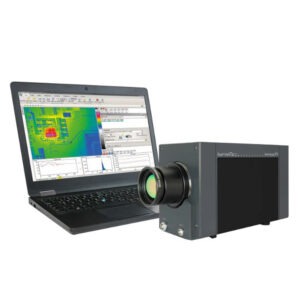
A modern interface concept forms the foundation for the performance and flexibility of the ImageIR® 9800 in terms of data acquisition and processing. Via the 10 GigE interface, high-resolution full-frame images with frame rates of up to 180 Hz can be stored and processed directly on a high-performance PC or laptop. Finally, the ImageIR® 9800 features four configurable digital and analogue inputs and two outputs for camera control and the output of control signals.