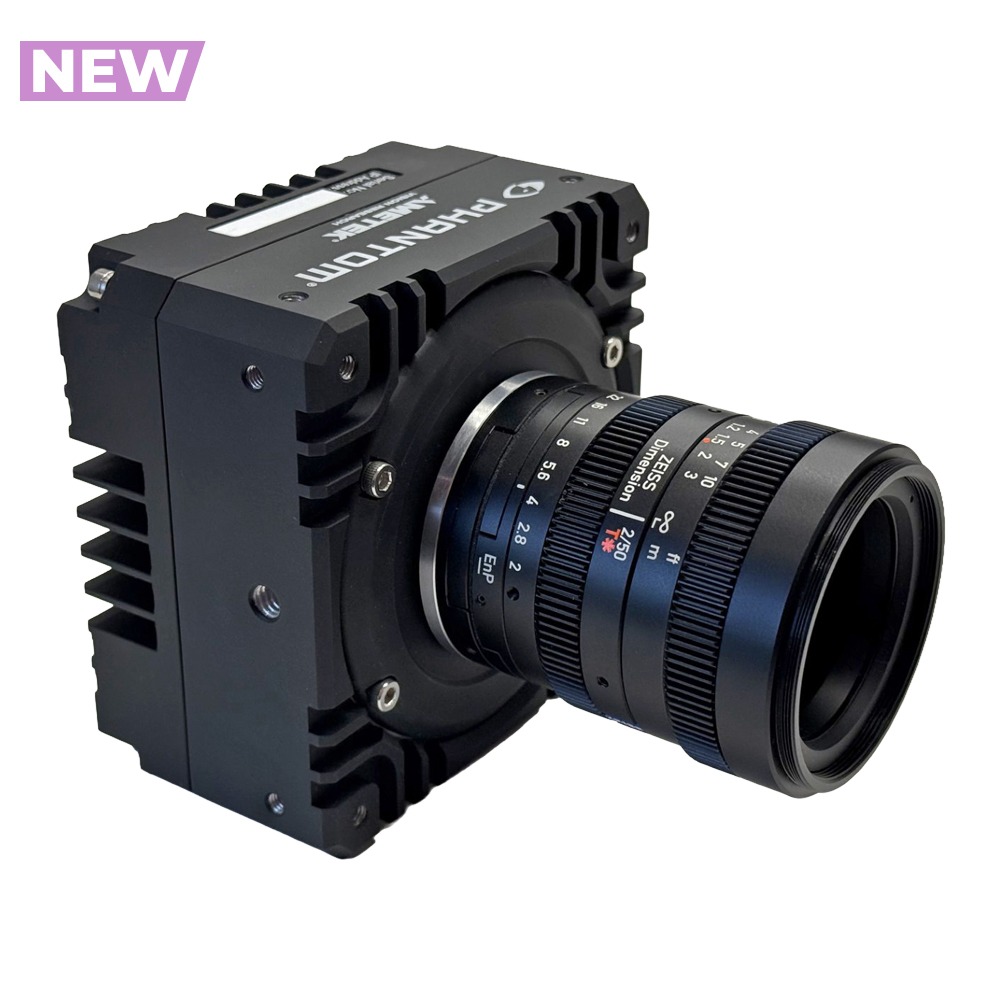
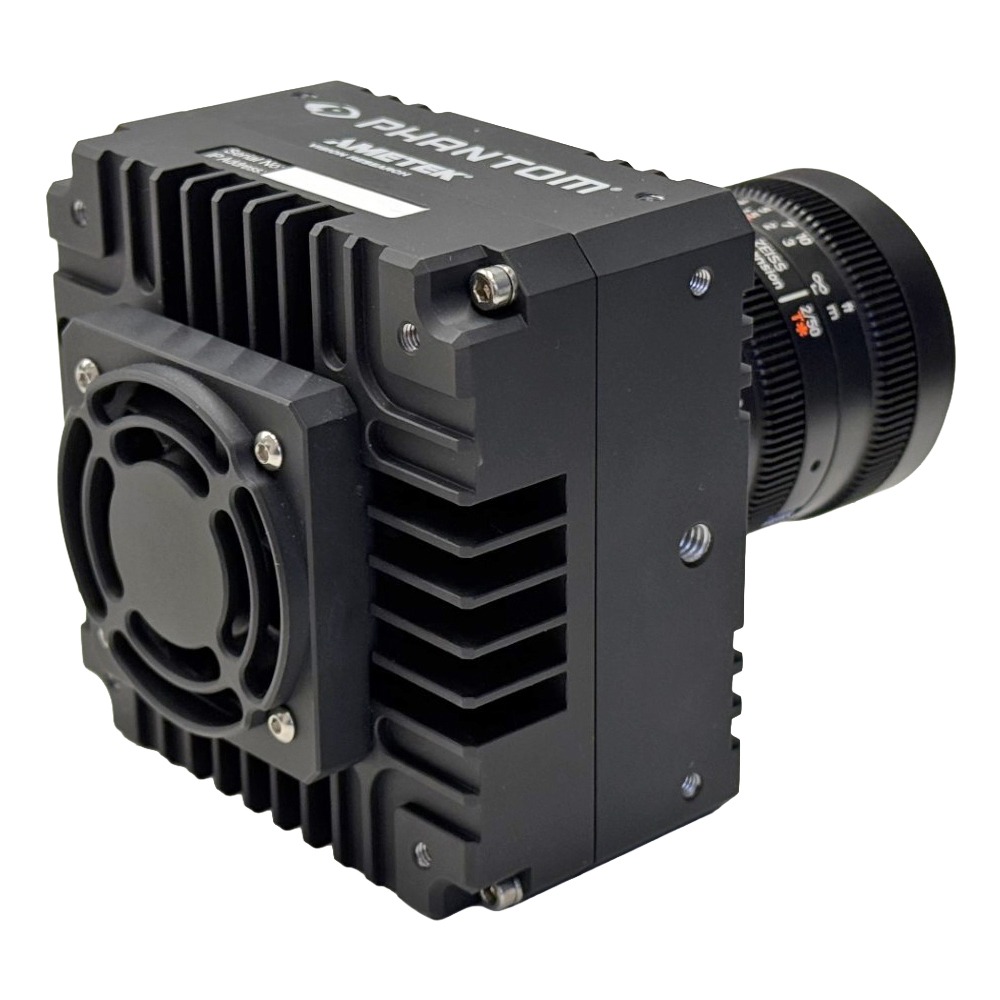
The Phantom S980v Machine Vision delivers ultra-high-speed imaging, fiber-native connectivity, and seamless system integration in a compact platform.
With CoaXPress over Fibre streaming, dual 40G QSFP+ interfaces, and a ForzaFAST581 global shutter BSI CMOS sensor, it provides immediate access to high-bandwidth image data. Meanwhile, it captures UHD image quality at frame rates up to 74,808 fps.
- 74,808 fps – Max. Frame Rate
- 3840 x 2160 – Max Resolution
- Sensor – ForzaFAST581 BSI CMOS, Global Shutter
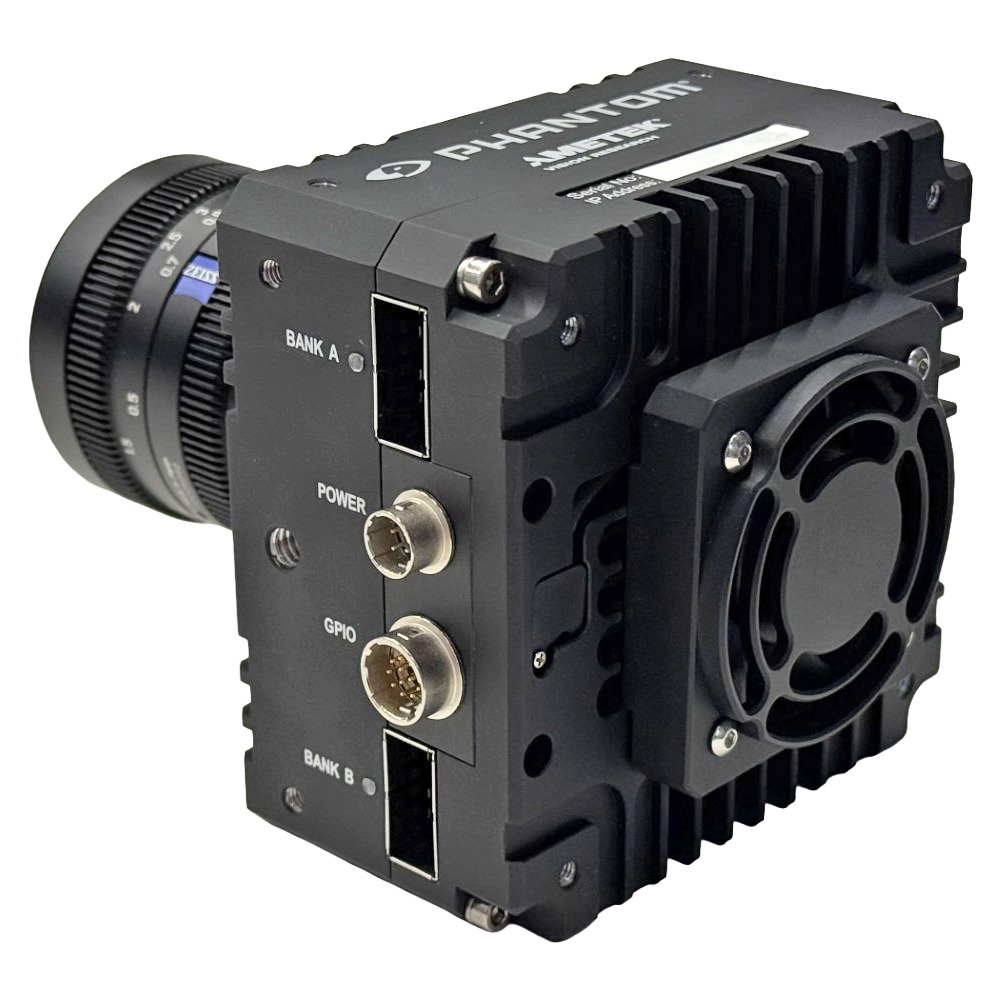
- RAM – Dual 40G QSFP+ / CXP over Fibre
- Min. Exposure – 1.9 µs
Ultra High-Speed Imaging Built for System Integration
The S980 is designed for systems that need high-speed image data available quickly for downstream processing, custom algorithms, and near real-time analysis. With CXP over Fibre and dual QSFP+ ports, it supports sustained high-bandwidth transfer into host systems. These systems are used in machine vision, biomedical, defence, industrial, and research environments.
- Fibre-Native Connectivity: Dual 40G QSFP+ ports with CXP over Fibre support high-bandwidth data transfer into host systems.
- High-Speed Continuous Capture: One- and two-bank operating modes plus windowed operation provide flexible performance scaling from UHD acquisition to ultra-high-speed ROI capture.
- Built for Immediate Data Access: The S980 is designed for workflows where images must move quickly into downstream processing and analysis.
Phantom Image Quality in a Machine Vision Form Factor
The S980 combines a 3840 × 2160 ForzaFAST581 backside-illuminated CMOS global shutter sensor with low-noise performance and great spatial detail. This makes it well suited for advanced research, defence, and industrial test environments where image quality and data integrity matter.
- BSI CMOS Sensor: Backside-illuminated sensor technology supports sensitivity and image quality for demanding imaging environments.
- Global Shutter Capture: Global shutter imaging supports accurate capture of fast events without rolling-shutter distortion.
- Low-Noise Performance: The datasheet positions the S980 for low-noise performance and great spatial detail.
Designed for OEM and Embedded Vision Systems
The S980 is compact, integration-ready, and built for system-level deployment. Its mechanical design, host-controlled architecture, GPIO capabilities, timecode support, and metadata streaming make it suitable for embedded platforms and OEM machine vision systems.
- Compact Integration: The S980 measures 3.75 × 3.75 × 2.5 in and weighs 1.8 lb / 0.82 kg.
- System Synchronisation: GPIO includes trigger, timecode, event signalling, ready output, strobe output, and user input/output signals.
- Embedded Architecture: The datasheet describes the S980 as host-controlled with firmware-only architecture and no embedded OS.
DATA YOU CAN TRUST IN THE HARSHEST REAL-WORLD CONDITIONS
- STREAM DATA DIRECTLY INTO HOST SYSTEMS: CXP over Fibre and dual 40G QSFP+ ports support sustained high-bandwidth transfer into machine vision and backend processing systems.
- CAPTURE EXTREME-SPEED EVENTS: Capture up to 1,075 fps at full 3840 × 2160 resolution and up to 74,808 fps at reduced resolution for high-speed ROI capture.
- SUPPORT CLOSED-LOOP WORKFLOWS: The S980 is positioned for high-speed image data streaming into architectures designed for immediate analysis and decision-making.
- SEE MORE DETAIL AT SPEED: The ForzaFAST581 BSI CMOS global shutter sensor provides 3840 × 2160 resolution with low-noise performance and high spatial detail.
- INTEGRATE INTO OEM PLATFORMS: Compact size, multiple mounting points, GPIO, timecode, and metadata streaming support integration into larger system architectures.
APPLICATIONS
Specific applications require specific consideration and the proper tool to capture a high-speed event. The application pages below demonstrate the use of Phantom cameras in a variety of testing methods and situations. Case studies provide Phantom camera customers with the knowledge necessary to make an informed decision.
Ballistics And Range
High-speed cameras are the ‘go-to’ analysis tool for those researching ballistics and range applications.
Combustion Imaging
Combustion applications often have unique difficulties that need to be overcome. Aside from being exceptionally fast events, they often have lighting issues as they quickly fluctuate between being very dark and very bright. Phantom cameras have features that aid researchers in dealing with these issues.
Material Analysis
High-speed cameras are used throughout the material analysis field. Researchers and engineers are largely deploying high-speed cameras to serve as a non-contact modality. These cameras help measure aspects of their materials testing, including basic kinematics, deformation, strain, and/or vibration.
Microfluidics
Microfluidics research is a growing field of research as more industries advance technology into the microscope realms. Whether in a laboratory or studying spray behaviour for industrial applications, Phantom cameras can be found nearby.
Transparent Flows
Transparent flows research allows for the visualisation of the movement of heat and pressure during a high-speed event. Transparent flow studies can display pressure and temperature gradients. Importantly, these gradients are not typically visible to the naked eye.
Cytometry Single-Cell Imaging
Capturing image-cytometry data at exceedingly high speeds brings about new physical challenges. Firstly, cells that move rapidly within the microchannel demand sensors capable of ultra-short exposure times
Particle Image Velocimetry
Particle Image Velocimetry (PIV) is a research method that allows scientists to observe the flow of air, water, and other invisible elements. Phantom cameras make particle tracking simple.
Digital Image Correlation
In the field of strain & vibration measurement, there has been a steady but consistent transition away from ‘contact sensors’ and toward ‘non-contact’ sensing based on imaging from high-speed cameras.
Laser Imaging
There are many high-speed imaging applications that demand integration with high-power pulse lasers (0.1 – 1 kW).
Low Light Imaging
Phantom high-speed cameras feature CMOS sensors with class-leading, low-noise performance that detect even minimal photon flux, providing optimal signal-to-noise ratio (SNR) across the entire sensor range.
Optical Spectroscopy
The very core of most optical spectrometers is either a CCD or CMOS sensor. This transduces a projected diffractogram into a UV/VIS spectrum (i.e., intensity vs wavelength). Due to the ultrafast readout of Phantom sensors, many researchers replace the slower sensor with a Phantom camera. Alternatively, they design in the necessary optics around a Phantom camera from the ground up.
Schlieren Imaging
Schlieren imaging is a special technique that utilises mirrors and filters to view invisible events such as shock waves. Phantom cameras have high-sensitivity and low-noise settings that help increase contrast and make these occurrences visible.
Workflow
Understanding workflow and how it can enhance your high-speed imaging experience is very helpful when planning one-time or time-sensitive events. Phantom cameras have a variety of options that can increase portability, connections, and data management to ensure operators are getting the best shots possible.</p>