Home » Link Gulf – Main Store Page » Medical BioPrinters » Regemat REG4Life BioPrinter
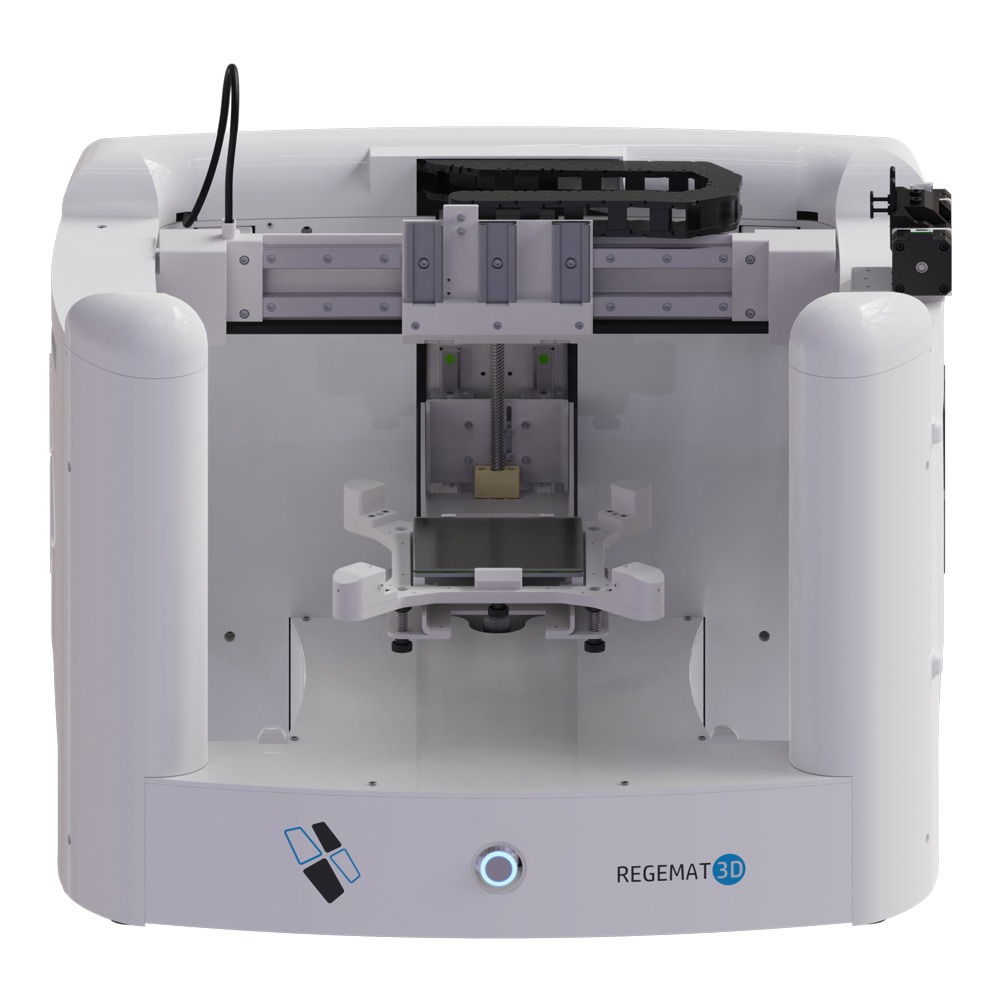
Regemat REG4Life BioPrinter
Key Features:
Pre-Order Now
Prices shown are for the United Arab Emirates only and exclude VAT @ 5% Local Rate (Unless Otherwise Stated).
Other countries may incur additional import duties.
Please Contact Us for further details and pricing for your country or location.
Regemat REG4Life BioPrinter
Key Features:
Each research project requires a specific configuration because no universal bioprinting system suits all applications. At Regemat 3D, we develop a customised Reg4Life version for each research group and project. The Reg4Life system uses a modular design that you can adapt for future studies without buying new equipment. Its Plug & Play print-head system lets you exchange heads quickly and easily for each printing process.
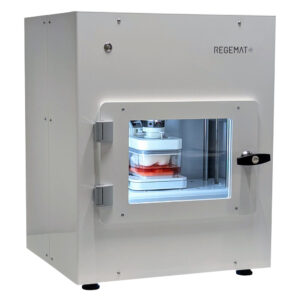
We built the Reg4Life entirely in PVC to reduce the weight to under 30 kg. Lightweight and grip handles allow easy transport and placement inside a laminar-flow cabinet. This placement improves aseptic working conditions beyond what HEPA filters provide. Our engineering team designed the bioprinter to promote upward laminar flow throughout the system.
A closed side compartment isolates filament rolls so they never disrupt laminar flow. We use rounded shapes to avoid corners where dirt and bacteria might accumulate. These features make cleaning and disinfection faster and easier. PVC covers support chemical disinfection, thermal shock treatments and UV or gamma sterilisation.
We constantly refine the system to ensure GMP-compliant, aseptic operation suitable for clinical translation.
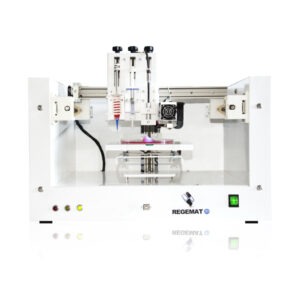
The new Reg4Life print head provides precise independent movement control across the X, Y and Z axes. Three Plug & Play print heads allow fast exchange of syringes and printing tools. A double thermoplastic extruder comes standard and prints two filaments during one process.
The integrated LED system guides users through each experimental stage with a three-colour code.
A laser sensor system performs automatic, precise calibration of all tools without user intervention. Software adjustments enable even finer calibration for different syringe types and nozzle diameters.
Our syringe system reflects over five years of global collaboration with research teams. This experience allows broad compatibility with diverse materials and bioinks. Reg4Life is the only system offering a refrigeration module operating from –20°C to 100°C.
We optimised the Reg4Life system to improve the entire bioprinting process. The hardware and software support precise control of FDM and IPF technologies. Reg4Life is the only commercial system validated for Regemat’s IVF technology.
FDM models scaffolds with complex external geometry and meshed internal structures. The extruder melts thermoplastic material and deposits it layer by layer.
IPF selects specific layers and injects cells directly into chosen pores. The system injects controlled cell volumes that may differ between layers. IPF supports cell survival under high-temperature thermoplastic conditions.
Regemat 3D exclusively developed IVF for complete bioink injection across scaffold volumes. IVF ensures full layer filling and supports small-volume work, including osteochondral repairs.
Regemat 3D developed the Reg4Life software to control every bioprinting parameter precisely. Users can customise configurations for each team and each bioprinting process. Regemat 3D Designer prints multiple objects simultaneously, each with independent settings.
Our intuitive software lets users design structures or import STL geometries. A preview tool enables configuration of the internal mesh and numerous printing parameters.
Reg4Life includes laser-based automatic calibration, a heated syringe, a heated bed and a double extruder. We offer additional configurations to meet the specific needs of each research team. We also design custom tools and software features when required. Our dual role as engineers and researchers allows full system customisation for collaborators.