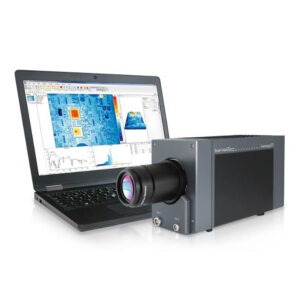
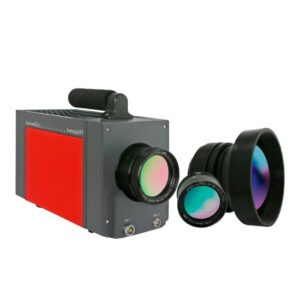
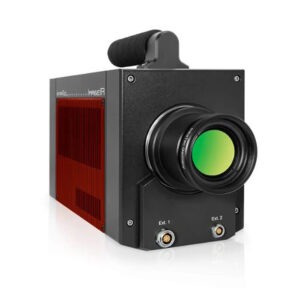
InfraTec ImageIR® 10300 – Full HD Infrared Camera for High Geometric Resolutions
With the ImageIR® 10300, users from industry and science can use a radiometric infrared camera whose cooled photon detector permits images in the format (1,920 × 1,536) IR pixels.
- Full HD resolution in 3 megapixel format
- Increased thermal resolution and frame rates with a constant field of view, thanks to high-speed mode
- Continuous measurements over large temperature ranges thanks to the MIT function
- Analysis of the smallest details with a 10x microscope
Detector Format 1920×1536
Efficient measurement of the smallest structures on large-scale objects
IR-Frame Rate 400 Hz
Analysis of extreme temperature changes and gradients
Measurement Accuracy 1%
Highly accurate and repeatable measurements
Thermal Resolution better than 22 mK
Precise detection of the smallest temperature differences
10 GigE Interface
High-speed, long-distance interference-proof data transmission
High-speed Mode
Increases frame rates and thermal resolution at the same time using binning technology
Complete Optical Assortment
Adaptation of the image geometry to almost every measuring situation
The long-term top model of the ImageIR® series symbolises InfraTec’s accumulated knowledge from 25 years of applied thermography. It incorporates the consequence of our own development efforts, which strive consistently for perfection.
And it reflects the skills of experienced engineers, who check each component’s suitability to produce, in the end, a precise high-tech measurement instrument.
The ImageIR® 10300, with its high geometric resolution, marks the current high point of the high-end camera series produced in Dresden. The detector format, in combination with the small pitch dimension of 10 µm, ensures that measurement, inspection and surveillance tasks can be solved even more efficiently than before.
Everywhere that very fine structures need to be analysed on large-surface measurement objects, for example, users save time, effort and thus costs.
Always Stay Flexible with the Modular System
Like the entire high-end camera series, the ImageIR® 10300 is also made up of several modules. This simplifies individual adaptation to your demands. Numerous components can be retrofitted even after the original configuration is established.
The modular design likewise includes the camera housing. Produced from high-strength aluminium, it is suited for use under rough environmental conditions due to its compact dimensions and low weight. The interfaces are equipped with industrial plug connectors that maintain the protection degree.
Master the Most Complex Measurement and Inspection Tasks Yourself
High object temperatures or specific material characteristics of the measurement objects can be analysed with thermographic systems, considerably more challenging. For such cases, InfraTec offers equipment with an optional aperture wheel and filter wheel. It is motorised and can be operated through the camera controller.
For example, if extremely high temperatures on objects are measured, the apertures weaken the respective radiation accordingly. With calibrated measurement ranges, a previously determined aperture is automatically selected and used for image recording.
If specific emission or transmission characteristics of the measurement object make the task more difficult, users can equip the aperture wheel and filter wheel of ImageIR® with filters. As a result, the camera’s range of use is expanded to cover the area of spectral thermography.
In this way, transmission is prevented with thin foils and only their purely emitted radiation is recorded for temperature measurement. The wheel offers room for up to five spectral filters or apertures, so the thermography system can be adapted to target the measurement and inspection task on site.
Further Functions
HighSense Function
Guaranteed Flexibility and Measurement Accuracy
Due to this innovative feature, the cameras’ measurement accuracy remains unchanged even when integration times or measurement ranges are altered. This will save users both time and money.
10 GigE Interface
Ultra-fast Data Transfer
High-resolution detectors and high frame rates generate large amounts of data. With the 10 Gigabit Ethernet interface, this data can be transferred quickly, reliably and without loss.
Filter & Aperture Wheel
Measurement of High Temperatures & Spectral Ranges
Up to two individually combinable wheels equipped with filters and apertures allow the camera sensitivity to be adjusted to the specific requirements of demanding measurement tasks.
Multifocus Function
Sharp Imaging of all Objects in the Frame
The innovative Multifocus function ensures that the quality of the images is completely independent of the depth of field of the lenses used or the distance of the test objects from the camera.
Thermal Resolution
Measure of Infrared Camera Performance
Thermal resolution (temperature resolution, NETD) describes the smallest temperature difference between objects or areas that an infrared camera can reliably detect and measure.
Trigger Interface
Interface for Incoming and Outgoing Control Signals
Trigger signals to or from the camera can be used to control and synchronise image data acquisition. Thermographic measurements can also be used to control processes.
Multi Integration Time
Temperature Measurements Across Multiple Calibration Ranges
This function allows continuous temperature measurements to be carried out with constant aperture and filter settings, covering more than one calibration range.
Solid Immersion Lens (SIL) for ImageIR®
In order to make particularly small structures clearly visible, an infrared camera with a large detector format is suitable. In some cases, special measurement and testing tasks require a further increase in spatial resolution. In the field of micro-thermography, high-performance infrared microscopic lenses are used for this purpose.
Their benefits can be further increased in conjunction with Solid Immersion Lenses (SIL). Mounted on the optics, these immersion media significantly improve the resolution of even the smallest structures in the µm range.