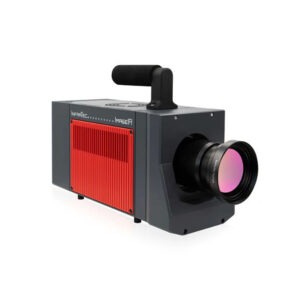
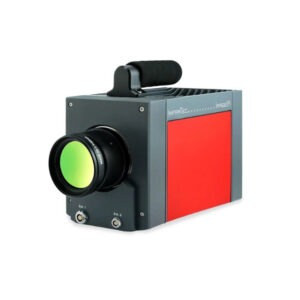
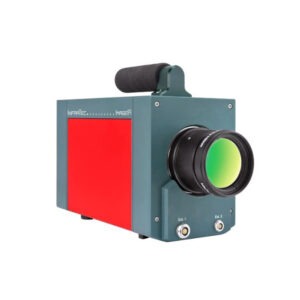
InfraTec ImageIR® 8800 – LWIR Camera with Shortest Integration Times
High resolution and speed – the cooled long-wave infrared camera
- Very short integration times, even at low object temperatures, for outdoor applications
- Very high frame rate
- Telephoto optics up to 200 mm available
- Shutter-free and precise long-term measurements in the LWIR range
Detector Format 640×512
A large detector enables the highest sensitivity
MicroScan 1.2MP
(1,280 × 1,024) IR pixels by genuine camera hardware
IR-Frame Rate 233hz
Analysis of extreme temperature changes and gradients in full frame
Measurement Accuracy 1%
Highly accurate and repeatable measurements
Shortest Integration Time
Accurate temperature measurements of fast processes
10 GigE Interface
High-speed, long-distance interference-proof data transmission
Spectral Range
Measurement in the range of (7.7…10.2) µm
Measure Precisely over a Long Time
A high long-term stability of the thermographic measurement with infrared camera systems of the ImageIR® 8800 series is achieved without any shutter by an excellent thermal decoupling of the electronics module, which will emit heat during its operation, from the optical and detector module, being most important for the signal reception.
Also, external temperature changes are being taken care of by a multitude of calibration curves and internal calibration routines.
Further Features
HDR Function
Display of Large Temperature Ranges Simultaneously
The HDR function enables thermograms with different integration times and filters to be created in quick succession and combined into a single image with large temperature differences.
Filter & Aperture Wheel
Measurement of High Temperatures & Spectral Ranges
Up to two individually combinable wheels equipped with filters and apertures allow the camera sensitivity to be adjusted to the specific requirements of demanding measurement tasks.
Multi Integration Time
Temperature Measurements Across Multiple Calibration Ranges
This function allows continuous temperature measurements to be carried out with constant aperture and filter settings, covering more than one calibration range.
MicroScan Function
Quadruple Geometrical Resolution
By using a fast-rotating MicroScan wheel, the number of pixels used can be quadrupled compared to the native pixel count of the FPA detector, significantly improving image quality.
GenICam Interface
The GenICam software interface, in conjunction with the GigE Vision interface, enables easy integration of infrared cameras into existing systems. The cameras are automatically detected.
Trigger Interface
Interface for Incoming and Outgoing Control Signals
Trigger signals to or from the camera can be used to control and synchronise image data acquisition. Thermographic measurements can also be used to control processes.
Auto Calibration
Automatic Adjustment for Precise Measurements
Auto Calibration automatically adapts the integration time, ensuring accurate temperature measurements and consistently high image quality, even under changing conditions.
Multispectral Feature
Flexible Multispectral Measurements
The multispectral feature enables recordings with changing spectral filters. This allows the measurement to be optimally adapted to different objects and tasks.
Thermal Resolution
Measure of Infrared Camera Performance
Thermal resolution (temperature resolution, NETD) describes the smallest temperature difference between objects or areas that an infrared camera can reliably detect and measure.
Increase Your Flexibility by Using the Modular Design Concept
The ImageIR® series is based on a modular concept and allows for successive upgrading and changes of powerful components like motorised lenses or a high-speed shutter. Already in its basic configuration, it can be delivered with different detectors which support your application the best way. Like this, you will always remain flexible and optimally adapt your camera systems to your respective needs.
Measure Correctly with an Accuracy of +/- 1%
If your measurement object has a temperature of 18.7 °C will always measure 18.7 °C, and exactly this is taken care of by the infrared camera systems of the ImageIR® 8800 series. You can rely on a correct measurement with an accuracy of +/- 1%
Easily Transfer Your Radiometric Data to the Computer
You will be able to work with both radiation proportional data formats and also directly with temperature data in °C or °F. You will receive the data by setting your specific parameters in the easy handling acquisition interface of the ImageIR® series at a frame rate of up to 2.5 kHz.
Highest Homogeneity will provide you with a Brilliant Picture
An infrared camera out of the ImageIR® 8800 series offers the highest homogeneity by combining cooled detector technology of the latest generation with other high-precision components. Precise thermography measurements, therefore, will not be influenced by any fixed pattern, and thermal images will be absolutely clear.
Avoid Measurement Errors Using Highest Geometrical Resolution of (640 × 512) Infrared Pixels
Compared with digital cameras operating in the visible spectrum, thermographic detector technologies still suffer from lower pixel numbers. Therefore, every pixel counts as in the former times of digital photography. The ImageIR® 8800 series offers you (640 × 512) pixels of the high-resolution detector.
Focus the Thermal Radiation Loss-free with Quality Lenses
In the field of thermography, low temperatures result in lower infrared radiation and thereby in a smaller signal for the infrared camera. That is why all the available signals should be used. The lens is the part of the infrared camera getting in touch with the infrared radiation, and therefore it plays an important role.
Precision lenses being coated with an anti-reflection film for avoiding disturbtions take care that the whole infrared radiation will be focussed to the detector of the ImageIR® 8800 series. You will find a wide range of lenses, such as telephoto or wide-angle lenses.
Acquire Thermal Images in a Millisecond of Time
The exact and fast control of the detectors of the ImageIR® 8800 infrared camera series provides the possibility to acquire and analyse thermal images at a time scale of milliseconds. Thereby, it allows an easy analysis of fast processes regarding their thermal changes. Thermal images can be stored at a frame rate of up to 100 Hz in full frame mode and provide insights into thermal changes of fast-running processes.