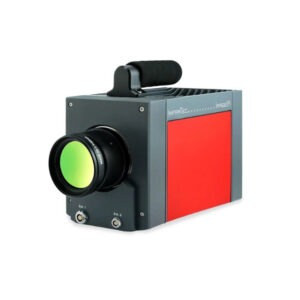
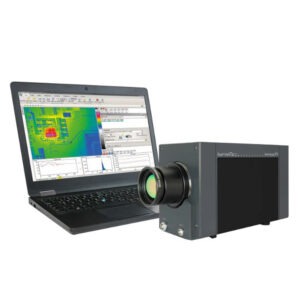
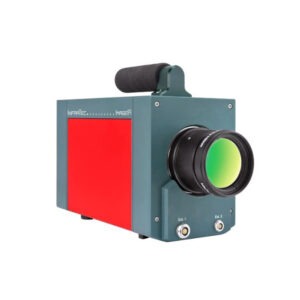
InfraTec ImageIR® 12300
The new ImageIR® 12300 from InfraTec is the radiometrically calibrated infrared camera with the world’s highest commercially available native resolution of 5.2 megapixels. The powerful top model of the ImageIR® series allows very fine structures on large area measurement objects to be resolved with unrivalled detail.
- High-performance photon detector with maximum native resolution of (2,560 × 2,048) IR pixels
- 5 µm pixel pitch to avoid geometrically induced measurement errors
- High-speed mode with frame rates up to 1,600 Hz
- Multispectral measurement thanks to sequences with continuously changing spectral filters
ImageIR® 12300: High-end Thermography Camera for Multifaceted Measurement tasks
Due to its extraordinarily high resolution, the ImageIR® 12300 can always bring its strengths to bear when large area measurement ranges need to be analysed in detail and at once. The use of the camera provides a significant increase in efficiency and provides maximum accuracy by preventing geometrically induced measurement errors.
Modern production technologies demand that ever larger area objects be examined in a consistent and greater level of detail. The new ImageIR® 12300 satisfies this requirement due to a cooled high-performance photon detector with a native resolution of (2.560 × 2.048) IR pixels. Furthermore, it combines maximum geometrical and thermal precision in one camera.
Standard cameras with (640 x 512) IR pixels need at least 16 consecutive measurements to achieve the same level of detail as the top model of the ImageIR® series from InfraTec. In these cases, a separate analysis of all 16 images may be required. Alternatively, merging them into a thermal image may also be necessary.
Instead, the ImageIR® 12300 renders the measurement not only in unrivalled image quality but in just one exposure. Therefore, this guarantees the synchronism of all data collected.
10 GigE Interface
Ultra-fast Data Transfer
High-resolution detectors and high frame rates generate large amounts of data. With the 10 Gigabit Ethernet interface, this data can be transferred quickly, reliably and without loss.
Filter Wheel / Aperture Wheel
The system design of ImageIR® thermographic cameras enables the integration of a motorised filter or aperture wheel, which can be individually equipped. One of the 5 or 7 positions can be selected via remote control.
Trigger Interface
Interface for Incoming and Outgoing Control Signals
Trigger signals to or from the camera can be used to control and synchronise image data acquisition. Thermographic measurements can also be used to control processes.
Multispectral Feature
The multispectral feature makes it possible to record sequences with constantly changing spectral filters. Images are recorded synchronously with a rapidly rotating filter wheel equipped with the filters.
It may be possible to switch between up to seven filters, depending on the version. Due to this, the multispectral measurement can be optimised to suit the measuring task if the preset ranges are unsuitable. The integration times can be adapted within the limits calibrated for this filter.
High-speed Mode
Faster Measurement with a Constant Field of View
Due to binning technology, infrared cameras have an additional high-speed mode in which the frame rate increases to more than three times, and the thermal resolution can be doubled.
Modular Concept
Customised Configuration and Retrofitting
Due to their modular design, the cameras in the ImageIR® series can be adapted to user requirements. In addition, they can be retrofitted or converted if measurement requirements change.
Infrared Lenses
Precision Lenses for a Wide Range of Requirements
Whether measuring the smallest details or monitoring over long distances, InfraTec provides high-quality, fast precision lenses for all types of thermographic analysis.
GenICam software interface
The GenICam software interface, in conjunction with the GigE Vision interface, enables easy integration of infrared cameras into existing systems. The cameras are automatically detected.
Thermal Resolution
Measure of Infrared Camera Performance
Thermal resolution (temperature resolution, NETD) describes the smallest temperature difference between objects or areas that an infrared camera can reliably detect and measure.
Integrated Intelligence for More Independence
The ImageIR® 12300 is equipped with high-performance electronics with impressive processing bandwidth. IR image data obtained can be recorded internally, analysed using implemented algorithms and used to control the high-end infrared camera.
The ImageIR® 12300 is designed for standalone operations completely without a PC. Alternatively, data can be output in real-time via various interfaces to high-resolution displays as well as for external processing or storage. The integrated web interface allows for operation and remote control of the ImageIR® 12300 by smartphone or tablet.
Master the Most Complex Measurement and Inspection Tasks Yourself
High object temperatures or specific material characteristics of the measurement objects can be analysed with thermographic systems, considerably more challenging. For such cases, InfraTec offers equipment with an optional aperture wheel and filter wheel. It is motorised and can be operated through the camera controller.
For example, if extremely high temperatures on objects are measured, the apertures weaken the respective radiation accordingly. With calibrated measurement ranges, a previously determined aperture is automatically selected and used for image recording.
If specific emission or transmission characteristics of the measurement object make the task more difficult, users can equip the aperture wheel and filter wheel of ImageIR® with filters. As a result, the camera’s range of use is expanded to cover the area of spectral thermography.
In this way, transmission is prevented with thin foils and only their purely emitted radiation is recorded for temperature measurement. The wheel offers room for up to five spectral filters or apertures. Thus, the thermography system can be adapted to target the measurement and inspection task on-site.