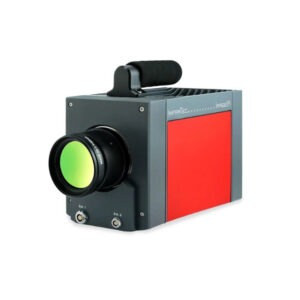
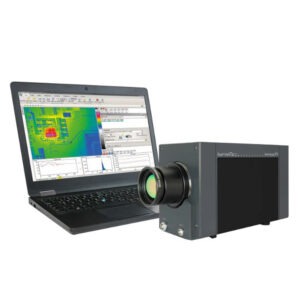
InfraTec ImageIR® 4300 – Your Entry into High-end Thermography
The entry door to spectral thermography
- Highest thermal resolution better than 20 mK
- High thermal sensitivity thanks to very large detector area (Pixel pitch 30 µm)
- Separate filter and aperture wheel design for high flexibility
- Very short integration times for distortion-free images of fast-moving measurement objects
Detector Format 320×256
A large detector enables the highest sensitivity
IR-Frame Rate 75 Hz
Analysis of extreme temperature changes and gradients in full frame
Measurement Accuracy
Highly accurate and repeatable measurements
Thermal Resolution 20 mK
Precise detection of the smallest temperature differences
Shortest Integration Time
Accurate temperature measurements of fast processes
Pitch Dimension 30 µm
Precise measurement of low temperatures and very fast integration times
GigE Vision Compatible
Standard interface for easy integration into existing process environment
Measure Precisely over a Long Time
A high long-term stability of the thermographic measurement with infrared camera systems of the ImageIR® 4300 series is achieved by an excellent thermal decoupling of the electronics module, which will emit heat during its operation, from the optical and detector module, being most important for the signal reception.
Focus the Thermal Radiation Loss-free with Quality Lenses
In the field of thermography, low temperatures result in lower infrared radiation and thereby in a smaller signal for the infrared camera. That is why all the available signals should be used. The lens is the part of the infrared camera getting in touch with the infrared radiation, at first, and therefore it plays an important role.
Precision lenses are coated with an anti-reflection film for avoiding disturbtions take care that the whole infrared radiation will be focussed to the detector of the ImageIR® 4300 series. Within this series of infrared camera systems, a wide range of lenses – starting with telephoto lenses up to microscopic lenses – can be found, too.
Solid Immersion Lens (SIL) for ImageIR®
In order to make particularly small structures clearly visible, an infrared camera with a large detector format is suitable. In some cases, special measurement and testing tasks require a further increase in spatial resolution.
In the field of micro-thermography, high-performance infrared microscopic lenses are used for this purpose. Their benefits can be further increased in conjunction with Solid Immersion Lenses (SIL). Mounted on the optics, these immersion media significantly improve the resolution of even the smallest structures in the µm range.
Make Use of Spectral Filters for Material Specific Measurements
Material-specific emissivity and transmissivity properties have to be taken into account while measuring with infrared camera systems. The integration of spectral filters makes use of those specifics for special measurements.
For example, spectral ranges of thin PE foils can be excluded in case they are highly transmissive or transparent. Like this, only the radiation will be measured, which is purely emitted by the foil itself. Based on its long experience in thermography, InfraTec can support you in selecting the right spectral filter.
The infrared camera systems of the ImageIR® series can integrate a remotely controllable filter wheel, which can hold up to four spectral filters. The filter position close to the detector can avoid warm aperture effects and allows for the usage of smaller and thereby cheaper filters in the infrared camera.
Extend Your Temperature Measurement Range with an Automatic Aperture Setting
The temperature measurement range of the ImageIR® infrared camera series can be widened by an integrated aperture wheel. The motorised aperture wheel can be controlled by the camera control itself. Working with calibrated measurement ranges, the appropriate aperture will even be automatically set in the infrared camera. When filter and aperture wheels are separately integrated, the ImageIR® camera series will be especially flexible in handling specific measurement situations.
Easily Transfer Your Radiometric Data to the Computer
You will be able to work with both radiation proportional data formats and also directly with temperature data in °C or °F. You will receive the data by setting your specific parameters in the easy handling acquisition interface of the ImageIR® series at a frame rate of up to 2.5 kHz.
Detect Smallest Temperature Differences Using High Thermal Resolution of 20mK
The thermal resolution of the ImageIR® infrared camera series allows you to measure the smallest temperature differences of (at 30 °C). Thermal images with a narrow temperature span display details absolutely sharp. You will find interesting signatures even there where other infrared camera systems cannot detect any temperature differences any longer.
Increase Your Flexibility by Using the Modular Design Concept
The ImageIR® series is based on a modular concept and allows for successive upgrading and changes of powerful components like motorised lenses or a high-speed shutter. Already in its basic configuration, it can be delivered with different detectors which support your application the best way. Like this, you will always remain flexible and optimally adapt your camera systems to your respective needs.
Further Functions
Window Mode
Fast Measurements in Defined Subsections
Capture very fast temperature and motion sequences in full, half, quarter and sub modes, as well as in sub image formats defined by click-and-drag, using high frame rates.
Thermal Resolution
Measure of Infrared Camera Performance
Thermal resolution (temperature resolution, NETD) describes the smallest temperature difference between objects or areas that an infrared camera can reliably detect and measure.
Multispectral Feature
The multispectral feature makes it possible to record sequences with constantly changing spectral filters. Images are recorded synchronously with a rapidly rotating filter wheel equipped with the filters. It may be possible to switch between up to seven filters, depending on the version.
Due to this, the multispectral measurement can be optimised to suit the measuring task if the preset ranges are unsuitable. The integration times can be adapted within the limits calibrated for this filter.
Trigger Interface
Interface for Incoming and Outgoing Control Signals
Trigger signals to or from the camera can be used to control and synchronise image data acquisition. Thermographic measurements can also be used to control processes.
HighSense Function
Guaranteed Flexibility and Measurement Accuracy
Due to this innovative feature, the cameras’ measurement accuracy remains unchanged even when integration times or measurement ranges are altered. This will save users both time and money.
Auto Calibration
The Auto Calibration option expands the HighSense function to include automatic, dynamic adaptation of the integration time. This ensures the utmost temperature measuring accuracy and an optimised signal-to-noise ratio throughout the process. The wellfill of a detector is usually optimal in certain areas of the dynamic range. If the measured object signal is outside these or user-specified limits, the integration time is readjusted.
Camera Remote Control
Wireless Measurement – Independent and Convenient
The functions of the stationary camera systems can be controlled via the integrated web interface using a smartphone or software, as well as via an additional tablet attached to the housing.
Motor Focus
Remote-controlled Focusing of the Thermal Image
Interchangeable standard lenses in the ImageIR® series can be equipped with a motor focus unit. This enables precise, remote-controlled, and fast focusing via the operating software.