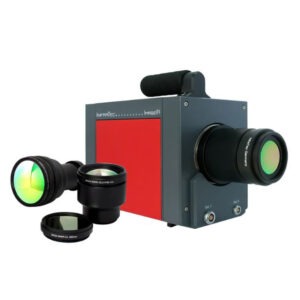
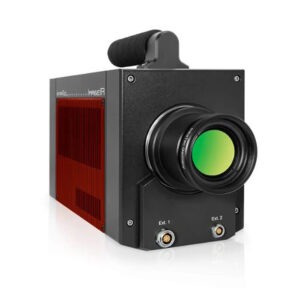
InfraTec ImageIR® 9300 – HD Image Quality meets High Sensitivity
The high-end infrared camera ImageIR® 9300 from InfraTec is a further top-of-the-range model of the high-end series ImageIR®.
- Large detector format of (1,280 × 1,024) IR pixels
- Extremely short integration times in the microsecond range
- Analysis of extremely small structures in the μm range
- Thermal resolution up to 25 mK
ImageIR® 9300 was developed for demanding operations in research and development, non-destructive material testing and process monitoring sectors. Its modular structure, which consists of optical-, detector- and interface-modules, makes it easily adaptable to the respective application.
Detector Format 1280×1024
Efficient measurement of the smallest structures on large-scale objects
IR-Frame Rate 106hz-1280x1024px
Analysis of extreme temperature changes and gradients in full frame
Measurement Accuracy 1%
Highly accurate and repeatable measurements
Thermal Resolution better than 25 mK
Precise detection of the smallest temperature differences
10 GigE Interface
High-speed, long-distance interference-proof data transmission
HighSense
Flexible setting of temperature measurement ranges/integration times beyond calibration ranges
Motor Focus
Precise, fast and remotely controllable, including multiple autofocus functions
Integrated Trigger and Process Interfaces
The camera series ImageIR® is equipped with a snapshot detector as well as with an internal trigger interface, which guarantees a repeatable, high-precision triggering. Two respective inputs and outputs are used to operate the camera or to generate digital control signals for external devices. Two digital channels of the data stream can be recorded synchronously with those trigger inputs.
Additional digital and analogue in- and outputs are available in connection with the process interface IRBIS® 3 process. Furthermore, extra information will be saved directly with the images.
Easily Transfer Your Radiometric Data to the Computer
You will be able to work with both radiation proportional data formats and also directly with temperature data in °C or °F. You will receive the data by setting your specific parameters in the easy handling acquisition interface of the ImageIR® 9300 series.
Avoid measurement errors using highest geometrical resolution of (1,280 × 1,024) infrared pixels
It is equipped with a cooled focal-plane-array photon detector with a format of (1,280 × 1,024) IR pixels. In combination with the outstanding thermal resolution of 0.025 K (25 mK), very high frame rates of 106 Hz and extremely short integration times of only a few microseconds, this camera offers you a whole new range of applications.
Detect Smallest Temperature Differences Using High Thermal Resolution of 25 mK
The thermal resolution of the ImageIR® infrared camera series allows you to measure the smallest temperature differences of 25 mK (at 30 °C). Thermal images with a narrow temperature span display details absolutely sharp. You will find interesting signatures even there where other infrared camera systems cannot detect any temperature differences any longer.
Take Advantage of the Modular Concept for Your Flexibility
The closed, industrial-suited, high-strength aluminium alloy housing is very compact and protects the sensitive sensors and electronics even during the roughest applications. It impresses with its low weight. The modular design allows for an application-specific configuration and later adaptation to varying demands. The interfaces are equipped with push-on connectors to uphold the degree of protection.
Further Functions
10 GigE Interface
Ultra-fast Data Transfer
High-resolution detectors and high frame rates generate large amounts of data. With the 10 Gigabit Ethernet interface, this data can be transferred quickly, reliably and without loss.
HighSense Function
Guaranteed Flexibility and Measurement Accuracy
Due to this innovative feature, the cameras’ measurement accuracy remains unchanged even when integration times or measurement ranges are altered. This will save users both time and money.
Filter & Aperture Wheel
Measurement of High Temperatures & Spectral Ranges
Up to two individually combinable wheels equipped with filters and apertures allow the camera sensitivity to be adjusted to the specific requirements of demanding measurement tasks.
Multi Integration Time
Temperature Measurements Across Multiple Calibration Ranges
This function allows continuous temperature measurements to be carried out with constant aperture and filter settings, covering more than one calibration range.
Trigger Interface
Interface for Incoming and Outgoing Control Signals
Trigger signals to or from the camera can be used to control and synchronise image data acquisition. Thermographic measurements can also be used to control processes.
Thermal Resolution
Measure of Infrared Camera Performance
Thermal resolution (temperature resolution, NETD) describes the smallest temperature difference between objects or areas that an infrared camera can reliably detect and measure.
Solid Immersion Lens (SIL) for ImageIR®
In order to make particularly small structures clearly visible, an infrared camera with a large detector format is suitable. In some cases, special measurement and testing tasks require a further increase in spatial resolution. In the field of micro-thermography, high-performance infrared microscopic lenses are used for this purpose.
Their benefits can be further increased in conjunction with Solid Immersion Lenses (SIL). Mounted on the optics, these immersion media significantly improve the resolution of even the smallest structures in the µm range.