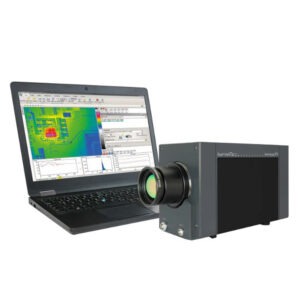
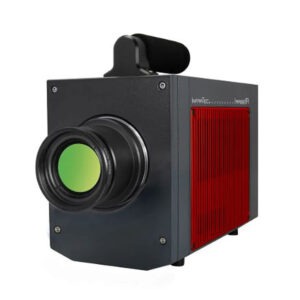
InfraTec ImageIR® 9400 – High-end Thermographic Camera with HD Image Quality
The benefits of the ImageIR® 9400 infrared camera are clearly based on its versatility. Especially users looking for a cooled camera with a high geometrical resolution will find an excellent solution with this model.
- Efficient measurement of the smallest structures on large-area measurement objects
- Highest geometric resolution thanks to MicroScan
- Expanded application possibilities thanks to rotating filter aperture wheel, e.g., for spectral thermography
- Extremely short integration times in the microsecond range
Detector Format 1280×1024
Efficient measurement of the smallest structures on large-scale objects
MicroScan 5.2M
(2.560 × 2.048) IR pixels by genuine camera hardware
IR-Frame Rate 180 Hz at 1,280 x 1,024 IR pixels
Analysis of extreme temperature changes and gradients in full frame
Measurement Accuracy 1%
Precise and highly repeatable measurements
10 GigE Interface
High-speed, long-distance interference-proof data transmission
HighSense
Flexible setting of temperature measurement ranges/integration times beyond calibration ranges
Motor Focus
Precise, fast and remotely controllable, including multiple autofocus functions
Trigger Interface
Interface for Incoming and Outgoing Control Signals
Trigger signals to or from the camera can be used to control and synchronise image data acquisition. Thermographic measurements can also be used to control processes.
Auto Calibration
Automatic Adjustment for Precise Measurements
Auto Calibration automatically adapts the integration time, ensuring accurate temperature measurements and consistently high image quality, even under changing conditions.
Detect Smallest Temperature Differences Using High Thermal Resolution of 30 mK
The thermal resolution of the ImageIR® infrared camera series allows you to measure the smallest temperature differences of Better than 0.03 K (at 30 °C). Thermal images with a narrow temperature span display details absolutely sharp. You will find interesting signatures even there where other infrared camera systems cannot detect any temperature differences any longer.
HighSense – Always the Optimal Camera Setting
Cameras of the ImageIR® series have a reliable factory calibration. Thanks to HighSense, ImageIR® users have the option of setting up individual temperature measuring ranges based on the factory calibration that best suit the respective task.
Depending on the measuring task, the required temperature range can be selected, and the optimum integration time for this purpose is calculated, or one decides to proceed in reverse order. Thus, the calibration can be retained even in the case of changed integration times.
The software also offers the possibility of storing a large number of such areas clearly arranged. Individually named and permanently stored, the operator can quickly access them. The same applies to changing, renaming and deleting profiles. HighSense is available for different camera models of the ImageIR® series. This function can optionally be added to systems already delivered.
Detect More on Smaller Objects
A well-balanced range of interchangeable, precise radiometric infrared lenses covers the fields of telephoto lenses, standard lenses, wide-angle lenses, as well as macroscope and microscope lenses. This again allows the adoption of the field of view for nearly every measuring situation. All changeable state-of-the-art standard optics of ImageIR® can be equipped with a motor focus unit.
It allows for precise, remotely controlled and fast motorised focusing and is part of a reliable autofocus function. Due to a diversity of microscope lenses, detailed images of electrical assemblies and components can be taken even from larger measuring distances with a pixel size of up to 5 µm.
10 GigE Interface for a Strong Increase in Output
The new 1 Gigabit Ethernet interface of the high-end camera series ImageIR® opens this extremely fast transmission standard with a NIC specially developed by InfraTec. This works with optical or electrical transceiver modules that are easy to change and are called SFP+.
For all models of the ImageIR® 8300 hp with their (640 × 480) IR pixel detectors, this leads to a transfer rate in the full frame mode up to 355 Hz. Users can store large quantities of data in a computer easily and reliably.
Different 10 GigE fibre SFP+ transceivers allow transmission ranges of up to ten kilometres with the same low sensitivity to electromagnetic interference. A corresponding standard SFP ensures backward compatibility with the conventional GigE interface. This combination allows the ease of use of the cameras with the new 10 Gigabit Ethernet interface in existing systems, though at a reduced transmission rate.
Solid Immersion Lens (SIL) for ImageIR®
In order to make particularly small structures clearly visible, an infrared camera with a large detector format is suitable. In some cases, special measurement and testing tasks require a further increase in spatial resolution. In the field of micro-thermography, high-performance infrared microscopic lenses are used for this purpose.
Their benefits can be further increased in conjunction with Solid Immersion Lenses (SIL). Mounted on the optics, these immersion media significantly improve the resolution of even the smallest structures in the µm range.
Maximum Flexibility of the Measurement Options
The infrared camera is equipped with a separate filter and aperture wheel with up to six free positions, which allows 30 combinations. A necessity for measurements of high object temperatures and spectral thermography.
Effectively Avoid Measurement Errors
The smaller the pitch dimension of a camera, the smaller pixel sizes are possible to prevent geometrically induced measurement errors. The very small pitch of 10 μm makes the ImageIR 9400 ideal for microthermography in electronics. In combination with an 8× microscope lens, the finest structures can be precisely resolved down to 1.3 μm.
Further Functions
HDR Function
Display of Large Temperature Ranges Simultaneously
The HDR function enables thermograms with different integration times and filters to be created in quick succession and combined into a single image with large temperature differences.
Multi Integration Time
Temperature Measurements Across Multiple Calibration Ranges
This function allows continuous temperature measurements to be carried out with constant aperture and filter settings, covering more than one calibration range.
High-speed Mode
Faster Measurement with a Constant Field of View
Due to binning technology, infrared cameras have an additional high-speed mode in which the frame rate increases to more than three times and the thermal resolution can be doubled.
Filter & Aperture Wheel
Measurement of High Temperatures & Spectral Ranges
Up to two individually combinable wheels equipped with filters and apertures allow the camera sensitivity to be adjusted to the specific requirements of demanding measurement tasks.
Multispectral Feature
The multispectral feature makes it possible to record sequences with constantly changing spectral filters. Images are recorded synchronously with a rapidly rotating filter wheel equipped with the filters. It may be possible to switch between up to seven filters, depending on the version.
Due to this, the multispectral measurement can be optimised to suit the measuring task if the preset ranges are unsuitable. The integration times can be adapted within the limits calibrated for this filter.
Motor Focus
Remote-controlled Focusing of the Thermal Image
Interchangeable standard lenses in the ImageIR® series can be equipped with a motor focus unit. This enables precise, remote-controlled, and fast focusing via the operating software.
Window Mode
Fast Measurements in Defined Subsections
Capture very fast temperature and motion sequences in full, half, quarter and sub modes, as well as in sub image formats defined by click-and-drag, using high frame rates.
Geometrical Resolution – Efficient Analysis of Complex Assemblies
InfraTec’s infrared cameras with cooled and uncooled detectors have native resolutions up to (2,560 × 2,048) IR pixels. Spatially high-resolution thermograms ensure that components and assemblies are imaged down to the smallest detail and thus defects can be reliably detected and precisely localised.
GenICam software interface
The GenICam software interface, in conjunction with the GigE Vision interface, enables easy integration of infrared cameras into existing systems. The cameras are automatically detected.
Thermal Resolution
Measure of Infrared Camera Performance
Thermal resolution (temperature resolution, NETD) describes the smallest temperature difference between objects or areas that an infrared camera can reliably detect and measure.