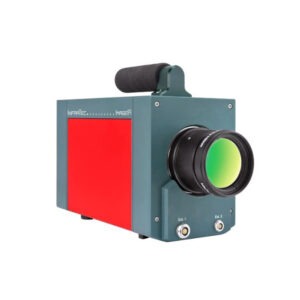
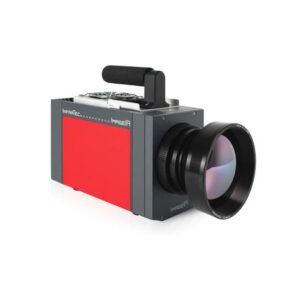
InfraTec ImageIR® 8300 – Universal Infrared Camera for Continuous Operation
The most solid all-rounder of the cooled infrared camera systems
- High measurement accuracy of ± 1%
- Flexible customization options
- Wide range of optics available
- Very long cooler running times, ideal for continuous operation
- Motorised focus for precise, remote-controlled, and fast focusing
Detector Format 640×512
A large detector enables the highest sensitivity
IR-Frame Rate 205 Hz
Analysis of extreme temperature changes and gradients in full frame
Measurement Accuracy 1%
Highly accurate and repeatable measurements
Thermal Resolution 20 mK
Precise detection of the smallest temperature differences
Rotating Filter Wheel and Aperture Wheel
Enables measurement tasks with high object temperatures and spectral thermography
Motor Focus
Precise, fast and remotely controllable, including multiple autofocus functions
Process and Trigger Interface
Highly precise, repeatable data recording; time- and event-controlled
Make Use of Spectral Filters for Material Specific Measurements
Material-specific emissivity and transmissivity properties must be taken into account when measuring with infrared camera systems. The integration of spectral filters uses these specifics for specialised measurements. For example, spectral ranges of thin PE foils can be excluded in case they are highly transmissive or transparent.
Like this, only the radiation will be measured, which is purely emitted by the foil itself. Based on its long experience in thermography, InfraTec can support you in selecting the right spectral filter. The infrared camera systems of the ImageIR® series can integrate a remotely controllable filter wheel, which can hold up to four spectral filters.
The filter position close to the detector can avoid warm aperture effects and allows for the usage of smaller and thereby cheaper filters in the infrared camera.
Extend Your Temperature Measurement Range with an Automatic Aperture Setting
The temperature measurement range of the ImageIR® infrared camera series can be widened by an integrated aperture wheel. The motorised aperture wheel can be controlled by the camera control itself.
Working with calibrated measurement ranges, the appropriate aperture will even be automatically set in the infrared camera. When filter and aperture wheels are separately integrated, the ImageIR® camera series is especially flexible in handling specific measurement situations.
Measure Precisely Over a Long Time
A high long-term stability of the thermographic measurement with infrared camera systems of the ImageIR® 8300 hs series is achieved by an excellent thermal decoupling of the electronics module, which will emit heat during its operation, from the optical and detector module, being most important for the signal reception.
Detect Smallest Temperature Differences Using High Thermal Resolution of 20 mK
The thermal resolution of the ImageIR® infrared camera series allows you to measure the smallest temperature differences of (at 30 °C). Thermal images with a narrow temperature span display details absolutely sharp. You will find interesting signatures even there where other infrared camera systems cannot detect any temperature differences any longer.
Acquire Thermal Images in a Millisecond of Time
The exact and fast control of the detectors of the ImageIR® 8300 series provides the possibility to acquire and analyse thermal images at a time scale of milliseconds. Thereby, it allows an easy analysis of fast processes regarding their thermal changes. Thermal images can be stored at a frame rate of up to 30,000 Hz and provide insights into thermal changes of fast-running processes.
Increase Your Flexibility by Using the Modular Design Concept
The ImageIR® series is based on a modular concept and allows for successive upgrading and changes of powerful components like motorised lenses or a high-speed shutter. Already in its basic configuration, it can be delivered with different detectors which support your application the best way. Like this, you will always remain flexible and optimally adapt your camera systems to your respective needs.